Introduction
Frequent calls connect the UK and Ireland, driven by strong business relationships and close personal ties. While seemingly straightforward, to call Ireland from UK requires following specific international dialing protocols. Getting these steps right is essential not just for connecting successfully but also for efficient communication and managing call costs effectively, particularly when evaluating options like Acepeak.
Many users encounter confusion with the correct dialing sequence – from the UK exit code and Ireland’s ISD/country code (353) to the critical detail of handling Irish area codes, especially dropping the leading ‘0’. This guide cuts through the confusion, providing a clear, step-by-step breakdown. We cover essential codes, number formats, common mistakes to avoid, cost-saving strategies, and the advantages of modern communication solutions, ensuring your calls are smooth and economical.
Why Getting UK-to-Ireland Dialing Right Matters
Understanding the correct procedure for phoning Ireland from the UK is more than just a technical exercise. It has real-world consequences for maintaining relationships and conducting business effectively. In our globally linked world, reliable and error-free communication isn’t a luxury; it’s fundamental.
Business Connectivity: Powering Cross-Border Operations
Reliable UK-Ireland calls are essential for smooth business operations involving clients, teams, and logistics. Dialing errors lead to costly delays and missed opportunities, while unmanaged international call expenses impact profitability. Efficient communication tools are therefore vital.
Personal Connections: Bridging the Distance
Maintaining strong personal ties with family and friends across the UK and Ireland depends on hassle-free, affordable phone calls. Knowing the correct dialing method prevents frustrating connection issues and strengthens these vital relationships.
Avoiding Frustrating Dialing Mistakes
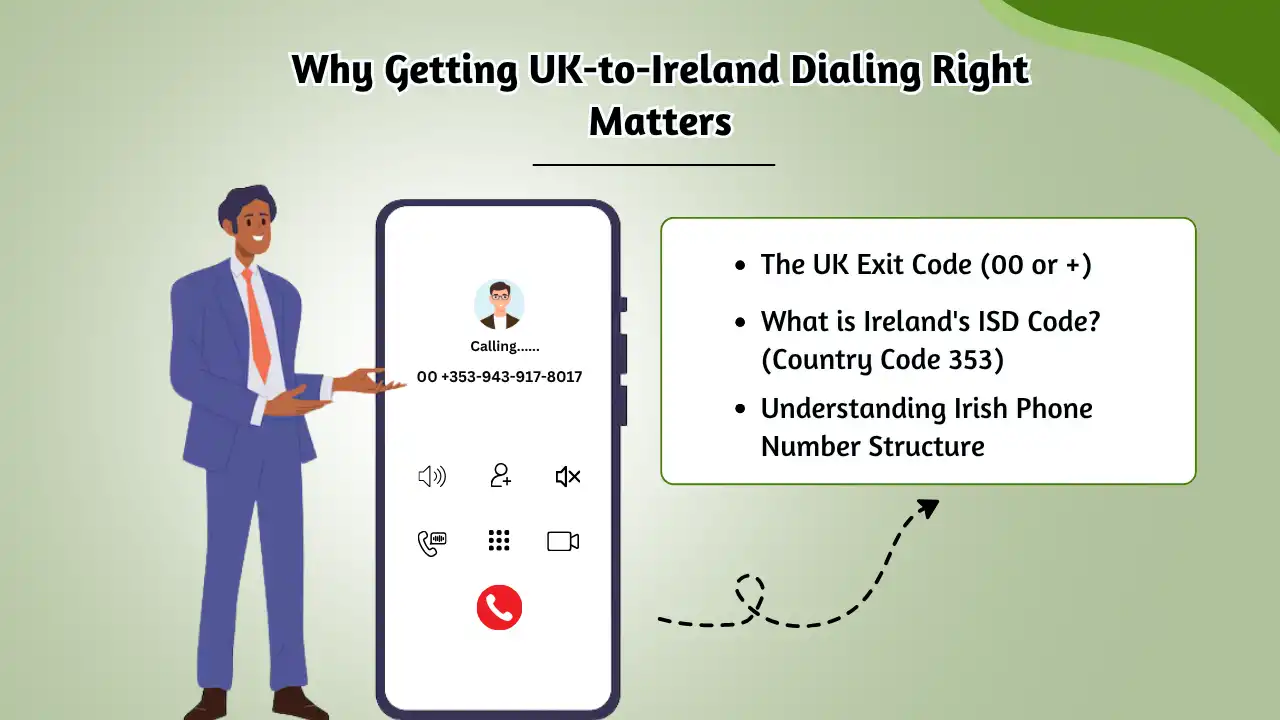
Common errors include forgetting the UK exit code (00 or +), using an incorrect country code (Ireland is 353), or crucially, failing to drop the leading ‘0’ from Irish area/mobile codes. Such mistakes waste time and can appear unprofessional; accuracy is key.
Getting Started: Key Area Codes You Need
Initiating an international call successfully requires understanding three key pieces of information: the signal you’re calling out of the UK, the specify you’re calling into Ireland, and how to structure the local Irish number.
The UK Exit Code (00 or +)
Before dialing any international number from the UK, you must first input the International Access Code, or ‘exit code’. This tells your phone provider to route the call outside the UK’s domestic network.
- From a UK Landline: The standard exit code is 00. Always dial this first.
- From a UK Mobile: You have two options. You can dial 00, or you can use the universal symbol +. To get the + sign, simply press and hold the 0 key on your mobile keypad. Using + is often recommended as it works globally, regardless of the country you are physically calling from.
What is Ireland’s ISD Code? (Country Code 353)
After the exit code, you need the specific country code for your destination. You might hear this referred to as the ISD (International Subscriber Dialing) code. For the Republic of Ireland, the ISD code / Country Code is 353. Dialing 353 after the UK exit code ensures your call is routed correctly to the Irish telephone network. Accuracy is vital here – dialing the wrong code means your call won’t reach Ireland.
Understanding Irish Phone Number Structure
Once the call reaches the Irish network via the 353 code, it needs further direction. This comes from the structure of the local Irish number itself, which typically consists of:
- An Area Code (NDC) or Mobile Prefix: These specify a geographic region (for landlines) or a mobile network allocation. Examples include 01 (Dublin), 021 (Cork), 087 (Mobile). Crucially, when dialing within Ireland, these codes start with 0.
- The Subscriber Number: This is the unique sequence of digits assigned to the specific landline or mobile phone you wish to reach. Its length can vary but is often 7 digits for mobiles and major cities.
The critical rule to remember when calling from the UK is how to handle that initial 0 on the area code or mobile prefix – you must drop it.
Step-by-Step Guide: Calling Ireland from the UK
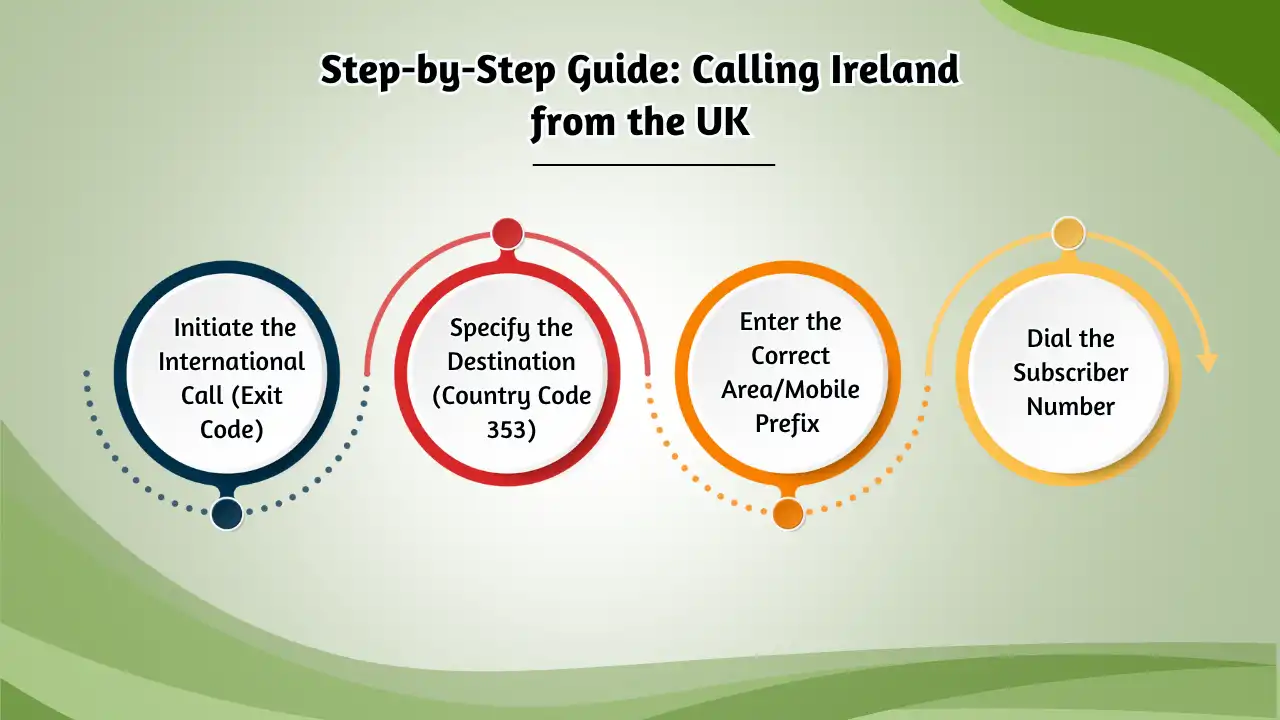
Let’s consolidate this information into a clear, actionable sequence. Follow these steps precisely for successful calls every time.
Step 1: Initiate the International Call (Exit Code)
Start with the UK international access code:
- Landline: Dial 00.
- Mobile: Dial + (recommended) or 00.
Step 2: Specify the Destination (Country Code 353)
Immediately follow the exit code with Ireland’s country code: 353.
- Sequence Check: 00 353 (from landline) or +353 (from mobile).
Step 3: Enter the Correct Area/Mobile Prefix (Crucial: Drop the ‘0’)
Identify the recipient’s Irish area code or mobile prefix. Now, apply the most important rule: omit the leading 0.
- For Dublin (01), dial 1.
- For Cork (021), dial 21.
- For Mobile (087), dial 87.
- For Galway (091), dial 91.
Step 4: Dial the Subscriber Number
Finally, enter the rest of the recipient’s local phone number accurately.
- Complete Example (calling Dublin 01 123 4567 from mobile): +353 1 1234567.
- Complete Example (calling mobile 087 123 4567 from landline): 00 353 87 1234567.
Verification: Ensuring the Call Connects
Once the full number is dialed, wait a few moments. If everything is correct, you should hear the standard ringing tone. If you get an error, systematically review each step, especially the dropped ‘0’, the country code 353, and the UK exit code (00/+).
Essential Reference: Irish Area Codes and Mobile Prefixes
A quick reference guide to common Irish dialing codes is invaluable. Always apply the “drop the leading 0” rule when using these codes for calls originating outside Ireland.
Understanding Geographic Area Codes (NDCs)
These codes route calls to specific landline regions within Ireland. They vary in length (one or two digits following the initial 0).
Common Mobile Network Prefixes
Prefixes like 083, 085, 086, 087, 089 are used for mobile numbers. Due to Mobile Number Portability (MNP), the prefix (83, 85, 86, 87, 89 when dialed from the UK) doesn’t reliably indicate the current network provider anymore, just the originally assigned range.
Table: Major Irish Area Codes & Mobile Prefixes
| Code (Within Ireland) | Primary Region(s) | Example Dialing from UK Landline (after 00 353) | Example Dialing from UK Mobile (after +353) |
| 01 | Dublin & Greater Dublin Area | 1 xxx xxxx | 1 xxx xxxx |
| 021 | Cork City & Area | 21 xxx xxxx | 21 xxx xxxx |
| 091 | Galway City & Area | 91 xxx xxxx | 91 xxx xxxx |
| 061 | Limerick City & Area | 61 xxx xxxx | 61 xxx xxxx |
| 041 | Drogheda Area (Part of 04) | 41 xxx xxxx | 41 xxx xxxx |
| 051 | Waterford Area (Part of 05) | 51 xxx xxxx | 51 xxx xxxx |
| 066 | Tralee Area (Part of 06) | 66 xxx xxxx | 66 xxx xxxx |
| 071 | Sligo Area (Part of 07) | 71 xxx xxxx | 71 xxx xxxx |
| 094 | Castlebar Area (Part of 09) | 94 xxx xxxx | 94 xxx xxxx |
| 083 | Mobile Prefix | 83 xxx xxxx | 83 xxx xxxx |
| 085 | Mobile Prefix | 85 xxx xxxx | 85 xxx xxxx |
| 086 | Mobile Prefix | 86 xxx xxxx | 86 xxx xxxx |
| 087 | Mobile Prefix | 87 xxx xxxx | 87 xxx xxxx |
| 089 | Mobile Prefix | 89 xxx xxxx | 89 xxx xxxx |
Interactive Element Suggestion
For maximum user convenience, especially for finding less common codes, incorporating a searchable tool on the webpage would be highly beneficial. Users could potentially enter an Irish town name and instantly see the correct area code and full dialing instruction from the UK.
Calling an Irish Mobile: Key Rules & Considerations
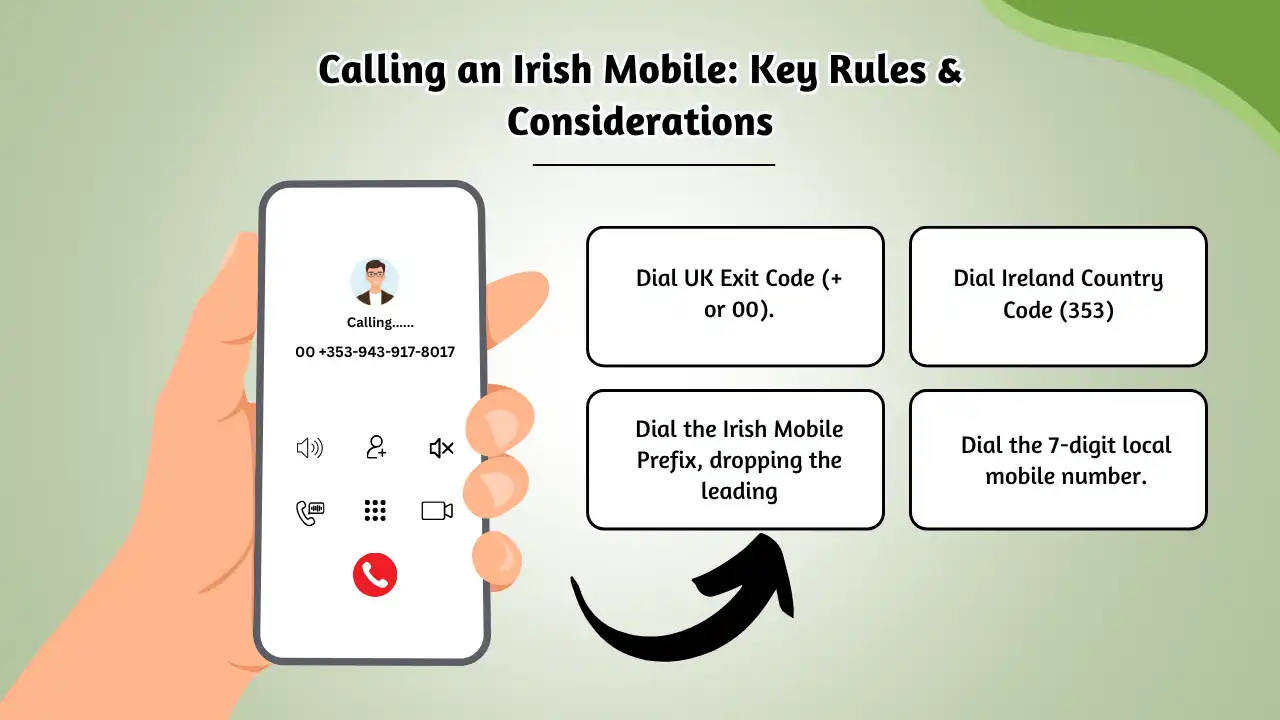
While the basic dialing steps apply to both landlines and mobiles, there are a few specific points worth noting when calling Irish mobile numbers from the UK.
Dialing Sequence Recap for Mobiles
Just to reiterate:
- Dial UK Exit Code (+ or 00).
- Dial Ireland Country Code (353).
- Dial the Irish Mobile Prefix, dropping the leading 0 (e.g., use 87 for 087).
- Dial the 7-digit local mobile number.
Important Rules & Tips for Calling Irish Mobiles from the UK
- The ‘Drop the 0’ Rule is Non-Negotiable: As stressed before, this is essential for connection. +353 87… is correct; +353 087… will fail.
- Check Your UK Mobile Plan Costs: Since Brexit, inclusive EU calling on UK mobile plans is less common. Calls to Irish mobiles might incur significant per-minute charges or require an international add-on. Verify your specific tariff to avoid surprises. Consider potential roaming charges if you are traveling outside the UK while making the call.
- Verify the Number: Ensure you have the correct 10-digit Irish mobile number (including the prefix like 08x) before you start applying the international format.
- Cost Differences vs. Landlines: Traditionally, calling international mobiles could be pricier than landlines due to mobile termination rates. While VoIP often equalizes this, check your specific provider’s rates if using traditional services.
- VoIP as a Cost-Saver: Services using Voice over IP often provide the most economical way to call Irish mobiles, frequently offering much lower per-minute rates or including calls within monthly bundles.
Pro Tips for Flawless Calls to Ireland
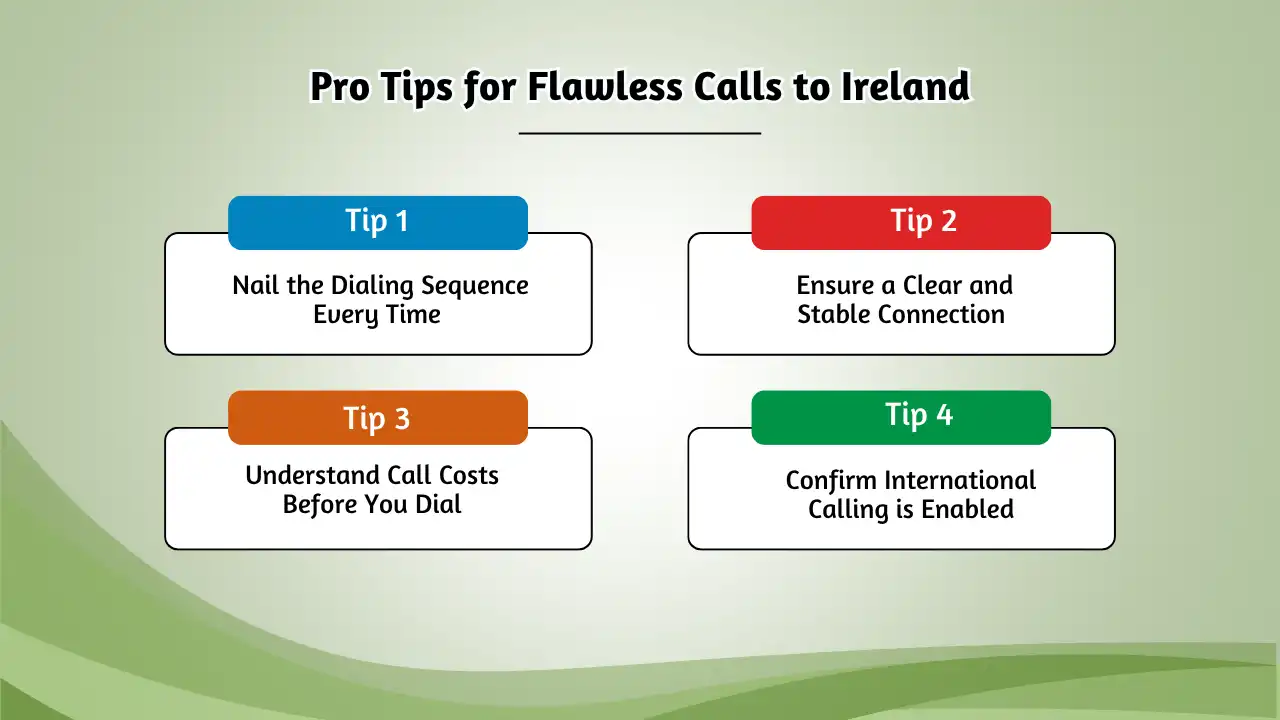
Making successful calls from the UK to Ireland consistently is easy when you incorporate a few best practices into your routine. Follow these tips to ensure smooth connections, clear conversations, and predictable costs every time you dial.
Tip 1: Nail the Dialing Sequence Every Time
The most common reason calls fail to connect is a simple error in the dialing sequence. Mastering this format is the first step to flawless calling:
- Verify the UK Exit Code: Always start with 00 from a landline or + (or 00) from a mobile. This signals you’re making an international call.
- Confirm Ireland’s Country Code: Double-check you’re using 353 immediately after the exit code. Accuracy here is crucial for routing.
- Drop the Leading ‘0’: This is paramount. Remember to omit the initial 0 from the Irish area code (e.g., use 1 for 01 Dublin) or mobile prefix (e.g., use 87 for 087). Including it will prevent the call from connecting.
- Check the Local Number: Ensure you have the complete and correct subscriber number for your contact in Ireland. Even one wrong digit means a failed call.
Taking a few extra seconds to verify each part of the number before hitting dial prevents frustration and saves time.
Tip 2: Ensure a Clear and Stable Connection
A successful connection is only half the battle; clear audio quality makes the conversation productive and enjoyable.
- For VoIP Users: Quality VoIP calls, like with Acepeak, demand stable internet. Test your connection speed before calls, minimize heavy traffic (streaming/downloads), and consider a wired connection for best clarity.
- General Connection Checks: Also quickly check your own equipment (phone, headset) for faults. Addressing issues at your end first is often simplest.
- Consider the Recipient’s End: If poor quality only occurs with one contact, the issue might be local to them in Ireland (like weak mobile signal).
Tip 3: Understand Call Costs Before You Dial
Avoid unpleasant surprises on your phone bill by being proactive about understanding the costs involved.
- Review Traditional Plans: If using a standard UK mobile or landline provider, take a moment to check their specific charges for calling Ireland (+353 numbers). Look up the per-minute rates (noting any difference between calling Irish landlines vs. mobiles), connection fees, and how calls are billed (per second or rounded up per minute). This knowledge prevents “bill shock.”
- Explore VoIP for Affordability: Often, the most predictable and cost-effective approach is using a VoIP service. Reputable providers offer transparent international rates that are typically much lower than traditional carriers. Exploring Acepeak’s affordable rates for Ireland can give you clear insight into potential savings and budget-friendly options.
Tip 4: Confirm International Calling is Enabled
Sometimes, the inability to connect isn’t due to dialing errors but rather a restriction on your line.
- Check for Call Barring: Your UK phone provider (mobile or landline) might have international calling barred by default on your account, especially on new contracts or some business plans.
- Verify Permissions: You can usually check this through your provider’s online account portal or mobile app under account settings or calling features. If unsure, a quick call to your provider’s customer service can confirm whether international calls (specifically to Ireland) are permitted on your plan.
Cost Considerations & Saving Money When Phoning Ireland
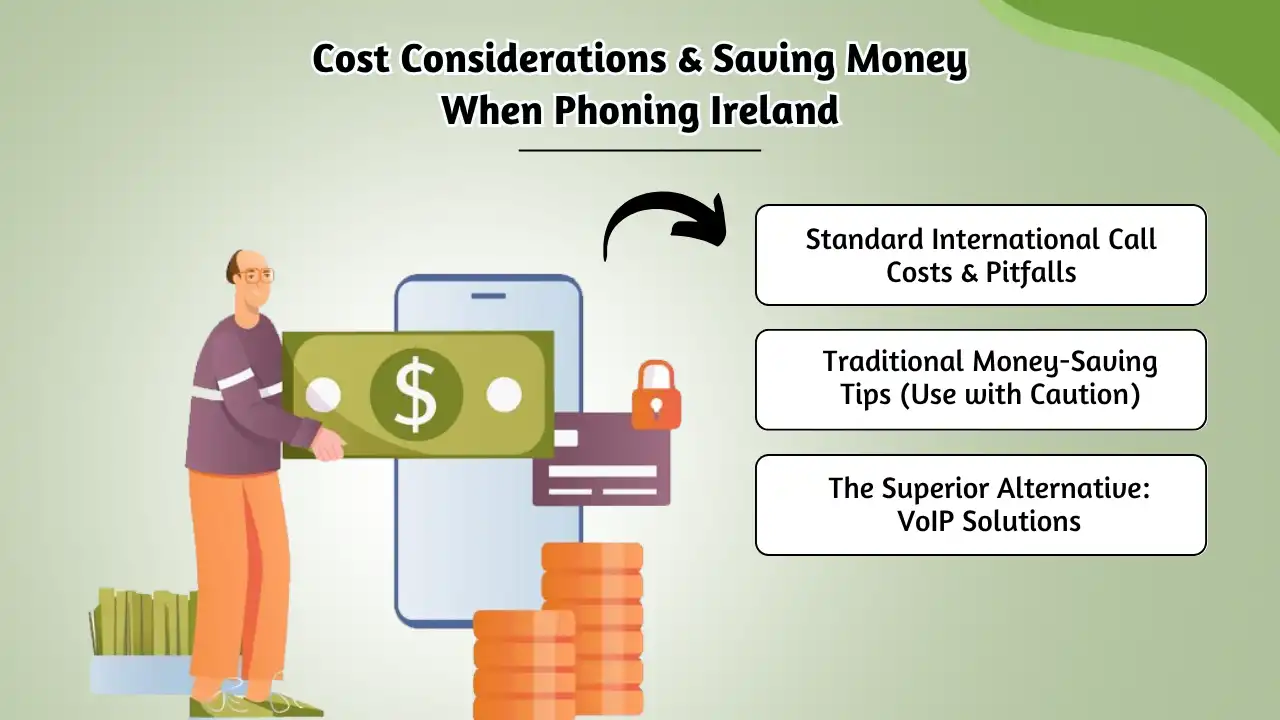
Making international calls doesn’t have to break the bank. Understanding the cost structures and exploring modern alternatives are key to economic communication.
Standard International Call Costs & Pitfalls
Calls from the UK to Ireland made via traditional phone companies (BT, Vodafone, O2, EE, etc.) are typically treated as international calls and billed accordingly. This often involves:
- Per-Minute Charges: Rates can be surprisingly high, especially for calls to mobiles.
- Connection Fees: Some plans add a fixed charge just for initiating the call.
- Billing Increments: Calls might be rounded up to the nearest minute, meaning a 65-second call is billed as 2 minutes.
- Lack of Transparency: Finding clear, unambiguous international rates can sometimes require digging deep into plan documentation.
Traditional Money-Saving Tips (Use with Caution)
Some methods have been used historically, but often have drawbacks:
- Calling Cards: Prepaid cards offer specific rates but can have hidden fees, poor connection quality, inconvenient access numbers, and expiry dates. Thorough research is essential.
- Checking Mobile Plan Add-ons: Some UK providers offer international calling bundles or add-ons. Analyze the cost versus the included minutes and destinations carefully; they may not always represent the best value compared to other options. Always check for roaming charges if you are outside the UK.
The Superior Alternative: VoIP Solutions
Voice over IP (VoIP) fundamentally changes the cost equation for international calls.
- How VoIP Works: It converts your voice into digital data packets sent over your existing internet connection, largely bypassing traditional international telephone network charges.
- The Value Proposition: This technological efficiency allows VoIP providers to offer substantially lower per-minute rates or generous bundles of international minutes within affordable monthly plans.
- How Acepeak Delivers Value: By optimizing internet routing and utilizing scalable cloud technology, Acepeak provides high-quality voice connections to Ireland at highly competitive rates, making it an excellent choice for both personal and business users looking to reduce their communication spend without sacrificing clarity.
- Exploring Affordable Rates: Transparency is key. Reputable providers allow you to easily check their call rates. Exploring Acepeak’s affordable rates for calling Ireland gives you clear insight into potential savings.
Best Time to Call Ireland from the UK
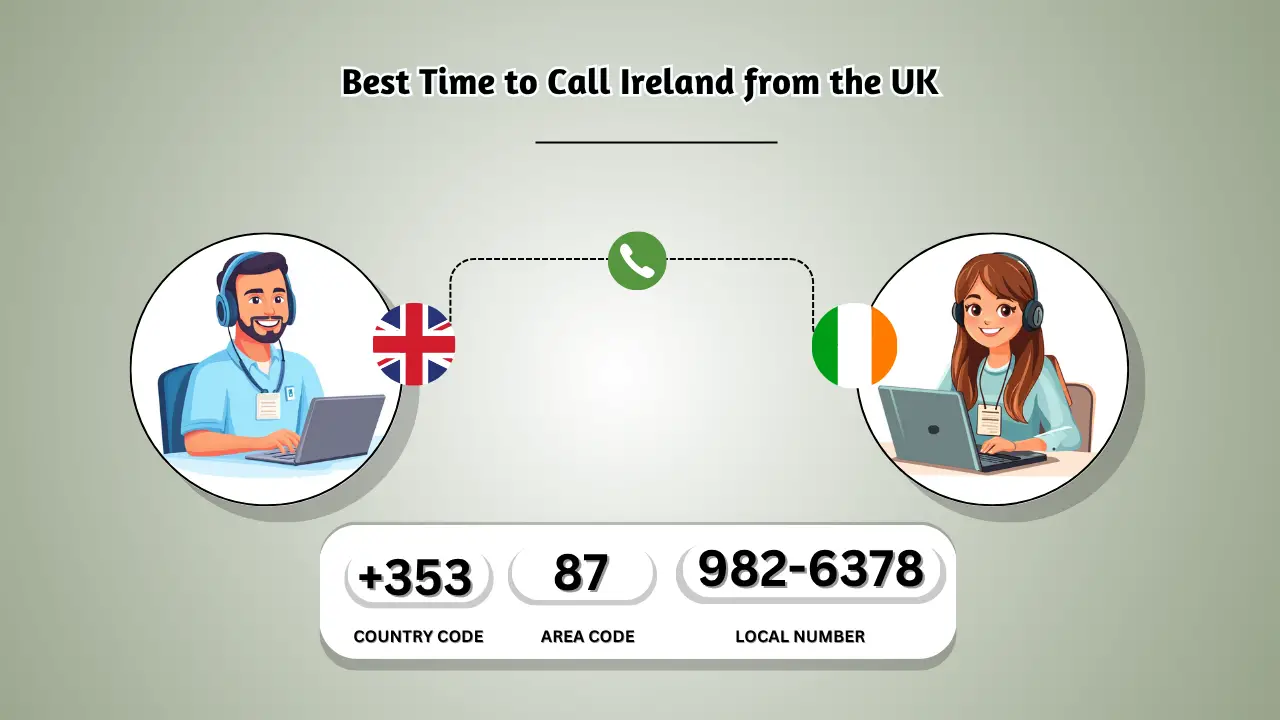
One common question when making international calls involves navigating time differences. Fortunately, this is one area where calling Ireland from the UK is exceptionally simple.
The Time Zone Advantage (No Difference!)
The Republic of Ireland observes the same time zone as the United Kingdom. Both countries are on Greenwich Mean Time (GMT/UTC) during the winter months and switch to Summer Time (GMT+1, known as Irish Standard Time/IST in Ireland and British Summer Time/BST in the UK) during the same periods (typically late March to late October).
This means there is no time difference to calculate. If it’s 11:00 AM in London, it’s also 11:00 AM in Dublin. You can confidently make calls during standard UK business hours or appropriate personal calling times without worrying about waking someone up or calling outside their working day due to time zone variations.
Enhancing Communication: Beyond Basic Dialing
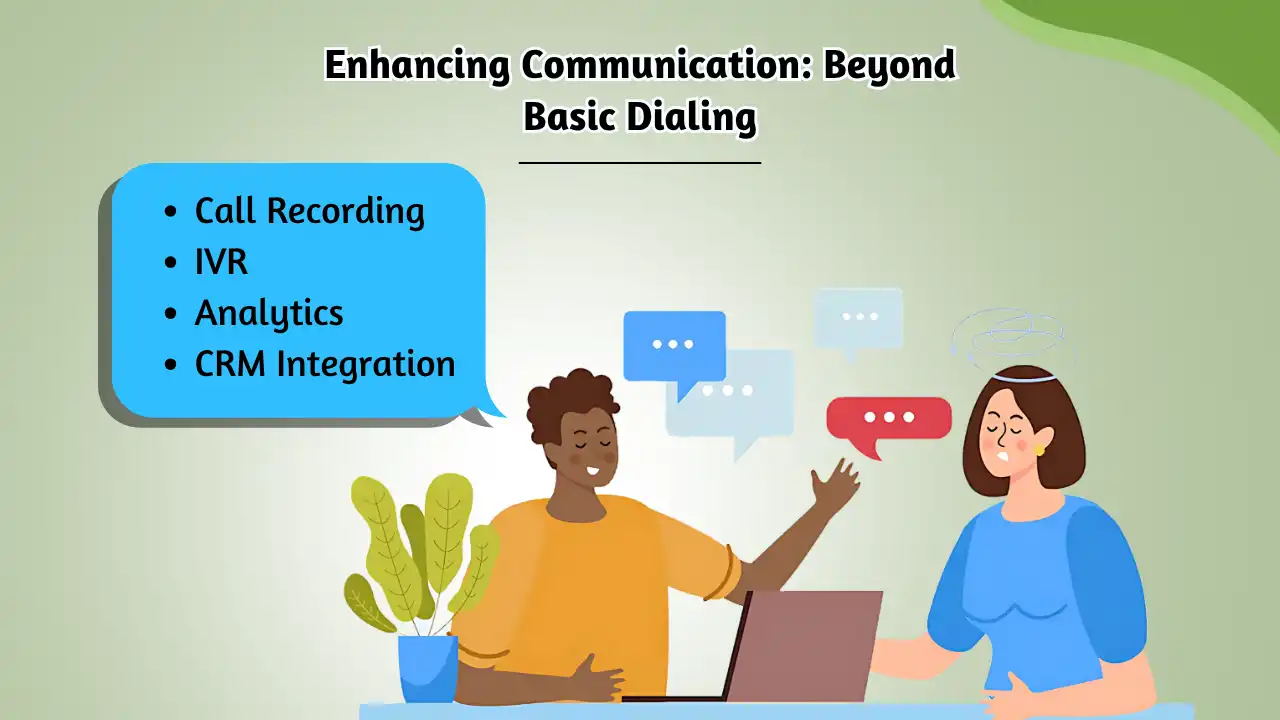
While this guide focuses on initiating the call, modern communication platforms offer much more, particularly for businesses seeking efficiency and professionalism.
Leveraging VoIP Features for Business
Platforms like Acepeak often provide a rich feature set beyond basic calling:
- Call Recording: Crucial for training, compliance, and record-keeping.
- IVR (Auto-Attendant): Professional call routing for incoming calls.
- Analytics: Data on call patterns to improve service.
- CRM Integration: Connecting call activity with customer data.
- Virtual Numbers: Obtaining an Irish number for local presence.
These tools elevate communication from a simple utility to a strategic business asset.
Ensuring Reliability and Uptime
Business communication demands consistency. Leading VoIP providers prioritize network resilience through geographically diverse infrastructure and Service Level Agreements (SLAs) to guarantee high uptime and call quality, often exceeding traditional network standards.
The Role of Customer Support
Effective support is vital. Having access to responsive technical assistance for setup, configuration, or troubleshooting ensures you get the most out of your communication system.
Conclusion
“In short, calling Ireland from the UK successfully hinges on the correct format: UK Exit Code (00/+), Ireland’s Code (353), the Irish Area/Mobile code (minus the leading 0), and the local number. While this ensures connection, traditional calling methods often bring high and unpredictable costs. Modern VoIP technology, leveraged by services like Acepeak, offers a vastly more efficient, affordable, and feature-rich alternative with crystal-clear quality and transparent billing. Optimizing your UK-Ireland calls means understanding both these dialing mechanics and the superior technology options available.